
Scipio was the man who finally beat Hannibal on the battlefield.
 Bronze bust of Scipio Africanus in the the Naples National Archaeological Museum (Inv. No. 5634), dated mid 1st century BC, from the Villa of the Papyri in Herculaneum, modern Ercolano, Italy (Creative Commons Attribution-Share Alike 3.0 Unported licensed photo by Miguel Hermoso Cuesta). Scipio earned the surname Africanus after his victory at the Battle of Zama

He was only twenty-seven when the Roman senate gave him command of the armies in Spain.
His dad and his uncle had just been killed and their armies annihilated.
The young Scipio somehow convinced the Roman leaders that he could go over there and win Spain for Rome. They gave him 35,000 soldiers, a small navy, and their blessing. At the time, Hannibal was still ravaging Italy. Things looked very bad.
 Map of Rome and Carthage at the start of the Second Punic War (218 BC)
Creative Commons Attribution-Share Alike 3.0 Unported licensed photo by William Robert Shepherd derivative work: Grandiose
Scipio had been following the Spanish wars very closely. There were three Carthaginian armies in the peninsula. How was he going to beat them? The obvious plan was to take on one army at a time. The danger was their joining up. There is mystery about how a senate of old men, however desperate, could give a young man, however sure of himself, such responsibility. But right from the beginning Scipio showed great leadership ability, independence of mind, boldness. His older officers urged him to engage the nearest Carthaginian army. He didn’t listen to them.
He had been working up a plan on his way over to Spain and when he arrived and got more information he decided to go ahead with it. He never told a soul about it until it was time to act. Then he called for Laelius, the commander of his navy. “Sail the ships down the coast toward New Carthage.”
“New Carthage?” It was the most important Carthaginian city in Spain. It had been founded by Hannibal’s brother-in-law.
“I’m going to march the army down there. Hug the coast and stay with us. We must keep in touch.”
 Map of Spain showing the location of Cartagena (Hannibal’s New Carthage), still an important naval base.
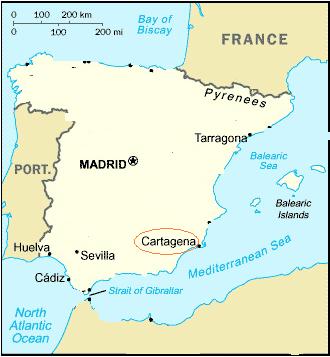
Scipio’s army reached New Carthage (the modern Cartagena) in seven days, according to Livy. Even twice that long would be like flying. While the soldiers marched they could sometimes see Laelius’ warships out on the water. Of course they didn’t know where the devil their new general was taking them.
No one, Carthaginian or Roman, would have guessed what Scipio was up to. He had three armies to fight and he was moving away from all of them.
His army took up a position north of the city and threw up a dirt wall behind it. Finally General Scipio addressed his puzzled soldiers.
“Comrades, we’re going to take New Carthage! (Cheers)
“No one expects us here and the garrison is down to a few men, who are now scared to death as they watch us from their walls. (Laughter)
“I have ordered Admiral Laelius to move into the harbor with his ships tonight and secure the port. Tomorrow you men will storm the city from the points I have shown your captains.
“Maybe you think: what’s one more city? Well, comrades, New Carthage is not just another city. We take New Carthage and we take Hispania itself. It is the richest city in Spain and the best port. It is our enemy’s arsenal, his granary, his warehouse. The treasury up there on that rock holds the money Carthage needs to pay her mercenaries. From here our ships will control the routes to Gades and the Pyrenees, and to Africa. In addition, the prisons of New Carthage hold hundreds of our friends—Celtiberian kings and princes and their families—and we will free them.”
This is the New Carthage that Scipio proposed to take, though here it is reconstructed as a Roman city, 250 years later.
 Cartago Nova, from the guide book of the Museo Arqueológico Municipal de Cartagena “Enrique Escudero de Castro”

Its citadel stands on the highest hill of a rugged peninsula. The beautiful gulf ( south of this map) is two and a half miles long and a mile wide. An islet at its entrance acts as a breakwater and keeps the winds out of the bay. A lagoon protects the city on the north and northwest side. Between the land masses there was a small strip of land in Scipio’s time. The Romans later removed it to join the sea to the lagoon and make it navigable; and they built a bridge and an aqueduct.
See Scipio Takes Command (Part 2) and learn how he took New Carthage and behaved himself when they offered him the most beautiful girl in the city.
..


 Great Names in History


